Now live across the Southern Plains — Amarillo · OKC · Fort Worth, and growing lane by lane


Equine Transport
How to Vet Horse Shippers Before Paying a Deposit
10 minutes read
Livestock Ways
Choosing horse shippers means trusting someone with your horse, your schedule and money paid before the trailer arrives. A professional-looking website or a reassuring phone call cannot establish whether the actual hauler has suitable equipment, relevant insurance or clear refund terms.
Before paying a deposit, verify who will haul the horse, what coverage applies and exactly what your payment reserves. The checks below help you separate a workable booking from one that needs more answers.
Establish who will actually haul your horse
Ask for the business’s legal name, physical business address, dispatcher’s name and the name of the carrier performing the trip. Compare those details across the quote, contract, invoice and payment request. A trade name can differ from a legal name, but the company should explain that relationship clearly.
Also ask whether you are speaking with the carrier, a booking service or someone arranging transportation through another company. If another carrier will perform the haul, identify that business before sending money.
Independently confirm contact information rather than relying entirely on links and phone numbers supplied in a message. An established company’s name or identification number can be copied by an impersonator.
A small operation without an elaborate website is not automatically a bad choice. The meaningful test is whether its identity, references and written commitments hold up when checked.
Check horse shippers against applicable carrier records
For a carrier operating under a USDOT number, look it up through the FMCSA SAFER Company Snapshot. Compare the legal name, address, operating status and listed operation with what you were told. Review available inspection and safety information, recognizing that a limited record is not proof of either excellent or poor performance.
A USDOT number is an identifier, not an endorsement or a guarantee of horse-care competence. A matching record also does not prove that the person messaging you represents that carrier.
Ask what federal and state requirements apply to the specific operation. Commercial interstate transportation, private transportation and intrastate hauling can fall under different rules. Livestock-related commodity exemptions can also affect federal operating-authority requirements, so a missing MC number alone does not settle whether a horse hauler is operating legally.
Where federal operating authority is required, check its status through the FMCSA Licensing and Insurance system. If the explanation remains unclear, confirm the requirement with FMCSA or the relevant state agency before paying.
Treat official records as one part of verification. They do not replace an equipment discussion, insurance confirmation or references from horse owners.
Verify insurance that could respond to a horse injury
When comparing horse shippers, ask more than “Are you insured?” Commercial auto liability, coverage for animals in transit and your horse’s own mortality or major-medical policy address different risks.
Request evidence of coverage for the carrier that will actually perform the trip. Then contact the insurance agent or insurer through independently verified contact information. Ask whether they can confirm active coverage and explain what documentation is available.
Useful questions include:
Does the policy cover horses while being transported, loaded and unloaded?
Does coverage apply to this carrier, equipment and type of trip?
What are the per-animal and per-occurrence limits?
Are there relevant exclusions, deductibles or valuation provisions?
What happens if another carrier or a substitute driver performs the haul?
A certificate of insurance is evidence of listed coverage, not the policy itself or a promise that a particular loss will be paid. Ask for clarification when the coverage description is vague.
For a valuable horse, discuss the trip with your own equine insurance agent as well. A carrier’s liability coverage should not be treated as a substitute for reviewing your horse’s protection. Do not assume that declaring a value in a booking form guarantees payment of that amount after a loss.
Match the trailer and handler to your horse
Ask for recent photographs of the trailer assigned to the trip, not just attractive fleet photos. Confirm the trailer configuration, usable stall space, partitions, ventilation, flooring and loading arrangement. Photos support a conversation but cannot establish mechanical condition on their own.
Explain the horse’s actual needs: size, age, loading behavior, travel experience and any veterinary restrictions. A quiet adult gelding and an inexperienced youngster may require different handling and space. Disclose known kicking, scrambling or separation problems before a trailer is reserved.
Experienced horse shippers should be able to explain how the proposed setup fits your horse rather than offering a blanket assurance that everything fits.
Ask who will handle loading and unloading, how the driver checks horses during the trip and what happens if the horse refuses to load. Sedation decisions belong with your veterinarian, not an improvised instruction from a dispatcher.
Request recent references for comparable trips. With each owner’s permission, ask whether the promised carrier arrived, how schedule changes were communicated and whether the final bill matched the agreement. A reference for a short local trip is less informative when you are booking a long shared route.
Get a realistic route and care plan
The shortest driving route does not necessarily describe the trip your horse will take. Shared hauling may involve additional pickups, delivery stops or layovers.
Confirm the pickup window, expected delivery window and whether those are estimates or contractual commitments. Ask what circumstances could change them and when you will be notified. A precise arrival promise is not especially useful if the company cannot explain its route.
Discuss water access, feeding instructions, monitoring, driver rest and any planned overnight facility. Ask whether the horse will be unloaded during a layover, where it will stay and whether it may encounter other horses. Repeated unloading is not automatically the safest choice; the plan should suit the horse, facilities and journey.
Reliable horse shippers should also explain their response to a breakdown, dangerous weather or a horse becoming ill. Agree on primary and backup contacts, veterinary authorization and how emergency expenses will be handled.
Check travel paperwork with your veterinarian and the destination state well before departure. Requirements and timing vary by destination and circumstances. Livestock Way’s guide to Coggins tests and health certificates by state provides a starting point, but current destination requirements should control the booking.
Put the deposit terms in writing
Define what the payment reserves
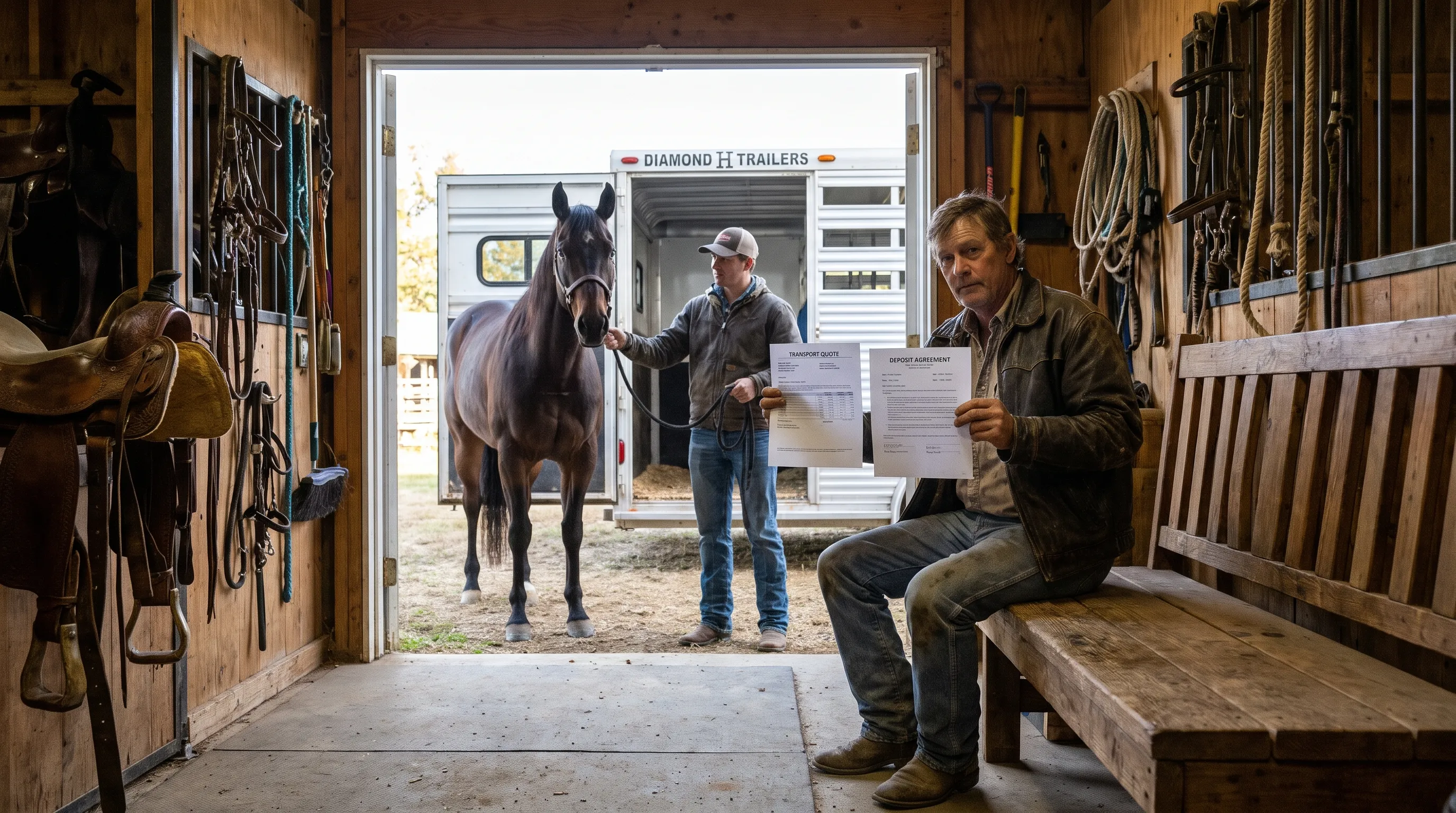
A deposit should connect to an identifiable service: a named carrier, a particular horse, a route, an equipment arrangement and an agreed pickup window. “We will get you on a truck” leaves too much unresolved.
The written agreement should identify the total price, deposit amount, remaining balance and when each payment becomes due. It should also explain possible additional charges, such as waiting time, boarding, route changes or an unsuccessful loading attempt. Ask whether those charges require your approval and how they are calculated.
Save the quote, contract and relevant messages together. If a later phone conversation changes the arrangement, request written confirmation before paying under the revised terms.
Separate cancellation, postponement and carrier failure
“Nonrefundable deposit” is not a complete cancellation policy. Ask what happens if you cancel, the horse becomes unfit to travel, required paperwork is delayed, weather disrupts the route or the carrier cannot provide the agreed service.
When reviewing horse shippers, compare those answers as carefully as the quoted price. A lower quote can create more financial exposure if the agreement leaves every disruption at your expense.
Have the contract distinguish between cancellation by you and cancellation by the carrier. It should address whether money is refunded, held as a credit or applied to a rescheduled trip, including any deadline for using that credit. Refund rights can depend on the agreement and applicable law.
Also ask whether the carrier may substitute equipment or transfer the booking to another company. Require notice and an opportunity to verify any replacement before your horse is handed over. A deposit paid to one business should not become an unexplained handoff to another.
Use a traceable payment method
Pay through a method that creates a clear record and gives you an opportunity to review applicable dispute protections. Those protections vary by payment provider, transaction type and circumstances; they are not guaranteed simply because a payment is electronic.
The payment recipient should match the verified business or have a documented, credible relationship to it. Stop if the recipient suddenly changes or you receive new banking instructions that have not been independently confirmed.
Gift cards, cryptocurrency, secrecy requests and pressure to send money immediately are strong reasons to pause. A personal payment account is not proof of fraud by itself, but it warrants additional verification and a proper business receipt. Do not choose a friends-and-family payment category just because someone says it avoids fees.
Make a clear go, pause or walk-away decision
Use the same standard for every quote. Comparing horse shippers becomes easier when you distinguish a missing document from an unresolved contradiction.
What you find | Practical next step |
|---|---|
Identity, carrier records, coverage and written terms align | Consider booking after resolving horse-specific needs |
A document is missing but the carrier cooperates with verification | Pause payment until it is supplied and checked |
Legal names or payment recipients differ without a clear explanation | Stop and independently verify the relationship |
The carrier refuses to identify the actual hauler or document terms | Choose another provider |
Pressure, impersonation signs or unexplained payment changes appear | Do not send the deposit |
A deposit request is not automatically suspicious, and a low deposit does not make a booking safe. The decision should rest on verifiable facts and an agreement you understand.
Keep the verified carrier’s contact information, invoice and trip details available for pickup day. Compare the arriving driver and equipment with the booking. A material last-minute change deserves fresh verification, even if you have already paid. The deposit is not a reason to ignore a new safety concern.
Frequently asked questions
How much deposit should I pay for horse transport? There is no single percentage that establishes a safe booking. Compare the amount with the total price, cancellation terms and what is being reserved. Before paying horse shippers, confirm who receives the money and what happens if the carrier cannot perform the trip.
Is a USDOT number enough to trust a hauler? No. Check that it belongs to the actual carrier and review applicable operating requirements. You still need to verify relevant insurance, trailer suitability, references and written booking terms.
Should I choose the lowest quote? Compare the complete service rather than price alone. Shared versus dedicated transport, route stops, stall arrangements and possible extra charges can make two quotes materially different. An unusually low price needs an explanation, not an automatic rejection or acceptance.
What if I already paid and now suspect fraud? Stop sending money, preserve the contract and messages, and contact your payment provider promptly about available options. Independently contact the real carrier if impersonation is suspected. The FTC’s guidance on payments to scammers explains reporting and recovery steps, although recovery is not guaranteed.
Find a match, then verify the booking
For horse moves across the Southern Plains, Livestock Way connects shippers and haulers directly through a livestock-only load board with upfront rates, rig-fit matching and free load posting.
Use that direct conversation to ask the questions above. Wherever you find horse shippers, pay a deposit only after the actual carrier, relevant coverage, horse-specific plan and written payment terms check out.