Now live across the Southern Plains — Amarillo · OKC · Fort Worth, and growing lane by lane


Load Board
What Load Rates Reveal About a Haul’s True Profit
10 minutes read
Livestock Way
The biggest number on a load board is not always the best offer. Load rates tell you what a haul pays, but not what you keep. A cattle run with a strong loaded-mile rate can leave less profit than a lower-priced offer once you count the empty approach, loading delays and time required to finish the job.
For owner-operators across the Amarillo, Oklahoma City and Fort Worth corridor, the useful question is whether the entire trip pays for fuel, equipment and your labor, then leaves enough profit to justify taking it. That requires looking beyond the posted payout and measuring the work attached to it.
Separate the payout from the profit
A quoted rate answers a narrow question: what revenue will this shipment generate under the agreed terms? It does not tell you how much work happens outside the loaded leg.
Your commitment starts when you leave your current location to position for pickup. It includes loading, delivery, required cleaning and the travel needed to reach your next workable position. A delivery close to another suitable pickup has different economics from one that leaves you stranded far from your regular lanes.
When comparing load rates, keep three numbers separate:
Gross revenue: The agreed haul payment plus any confirmed additional charges.
Trip contribution: Revenue minus the costs that arise from taking this particular job.
Estimated trip profit: What remains after also allowing for your labor and the trip’s share of equipment ownership and overhead.
Trip contribution can help you decide whether a load improves an otherwise empty return. But repeatedly accepting work that contributes toward overhead without fully covering it is not a sustainable pricing strategy.
Set a profit floor before negotiating
Build your estimate from your own operating records, not another driver’s cost-per-mile claim. Two haulers running the same lane can have different fuel economy, equipment costs and labor requirements.
A useful starting formula is:
Minimum acceptable payment = mileage costs + labor cost + allocated ownership and overhead + other trip costs + target profit.
Mileage costs include fuel and a realistic maintenance-and-tire allowance. Labor covers all working time associated with the job, not just driving. Ownership and overhead can include depreciation, financing interest, insurance, permits and administration.
Avoid double counting: loan principal is a cash-flow obligation, not an additional expense to add on top of depreciation. Keep repair reserves separate from equipment replacement allowances, too.
Your profit floor makes load rates easier to judge because it turns “that sounds decent” into a comparison against a defined minimum. The figure is still an estimate, but it gives negotiations a defensible starting point.
Pay yourself before calling the remainder profit
An owner-operator’s labor is not free simply because no separate payroll payment leaves the account. If a trip leaves $700 before compensating you for 14 hours of work, that entire $700 is not business profit.
Assign a reasonable hourly labor allowance using your compensation needs and business structure. Count pre-trip checks, loading supervision, unloading, cleaning and paperwork alongside driving. Schedule the trip within applicable driving and duty limits; a profitable spreadsheet does not make an infeasible schedule acceptable.
Waiting time deserves particular attention when assessing load rates. A delay can consume labor, add idling fuel and prevent you from accepting the next job.
Time-based cost exposure also appears outside trucking. This Dutch breakdown of on-demand chauffeur costs discusses assignment duration, waiting and vehicle arrangements. Its prices are not livestock-hauling benchmarks, but the costing principle applies: define the full service commitment before evaluating the quote.
Compare load rates using a fully costed trip
Consider two hypothetical cattle loads. Offer A pays more overall and has the stronger loaded-mile rate. Offer B requires fewer empty miles and less working time.
These are illustrative assumptions, not current market rates or recommended livestock-hauling prices. Both trips use a blended fuel economy of 6 mpg, diesel at $3.60 per gallon, a maintenance-and-tire allowance of $0.25 per mile and a labor allowance of $30 per hour. Each receives a $180 ownership-and-overhead allocation, assuming each occupies one planned operating-day slot.
Trip measure | Offer A | Offer B |
|---|---|---|
Agreed haul payment | $1,800 | $1,700 |
Loaded miles | 400 | 500 |
Empty miles associated with the trip | 200 | 40 |
Total miles | 600 | 540 |
Revenue per loaded mile | $4.50 | $3.40 |
Revenue per total mile | $3.00 | $3.15 |
Estimated working time | 13 hours | 11 hours |
Fuel cost | $360 | $324 |
Maintenance-and-tire allowance | $150 | $135 |
Driver labor allowance | $390 | $330 |
Ownership-and-overhead allocation | $180 | $180 |
Other trip costs | $120 | $100 |
Total estimated cost | $1,200 | $1,069 |
Estimated profit before tax | $600 | $631 |
The other trip costs represent assumed job-specific cleaning, bedding or toll expenses. Actual requirements differ between cattle and horse transport, so use the charges relevant to your equipment and shipment.
Offer B produces $31 more estimated profit despite paying $100 less. It also leaves two more working hours available, although those hours only create additional revenue if another suitable job can actually be booked.
Check how easily the advantage disappears
A narrow profit advantage needs a sensitivity check. If Offer B takes two additional unpaid working hours, its labor allowance rises by $60. Estimated profit falls from $631 to $571 before accounting for any additional idling fuel.
That reverses the comparison with Offer A. The posted load rates have not changed, but the better business choice has.
Test uncertain inputs before accepting: loading time, delivery access, actual positioning miles and fuel consumption. Use your own fuel cost per mile rather than treating the example’s diesel price as a current quote. If a small, plausible delay wipes out the expected margin, the offer needs better terms or a larger profit cushion.
Confirm the details that can change your margin
A visible payout is a starting point for a conversation, not a substitute for confirming the job. Before committing, establish the animal count or weight basis where relevant, trailer requirements, pickup window, delivery arrangements and who pays for any required cleaning or bedding.
Clarify what happens if the shipment changes after you position the truck. A reduced animal count may affect a per-head payment. A rescheduled pickup can consume a day’s capacity. Additional stops can add mileage and handling time without appearing in the original quote.
Compare load rates only after confirming whether fuel surcharges, detention and other additional payments are included, separately payable or unavailable. Put agreed terms in writing rather than building projected profit around an unconfirmed extra.
The empty leg needs the same scrutiny. Practical ways to cut empty miles between loads can improve a lane’s economics, but do not budget revenue from a return load that has not been secured.
Distinguish profit from money in the bank
A trip can look profitable and still put pressure on cash flow. Fuel may be paid today while the invoice is collected weeks later. Maintenance allowances and depreciation may not leave your account immediately, yet they represent real costs of operating and replacing equipment.
Check payment timing, required delivery documentation and any processing or quick-pay fee before booking. If a fee applies, subtract it from expected revenue. Late payment also ties up working capital, even when the eventual invoice amount stays unchanged.
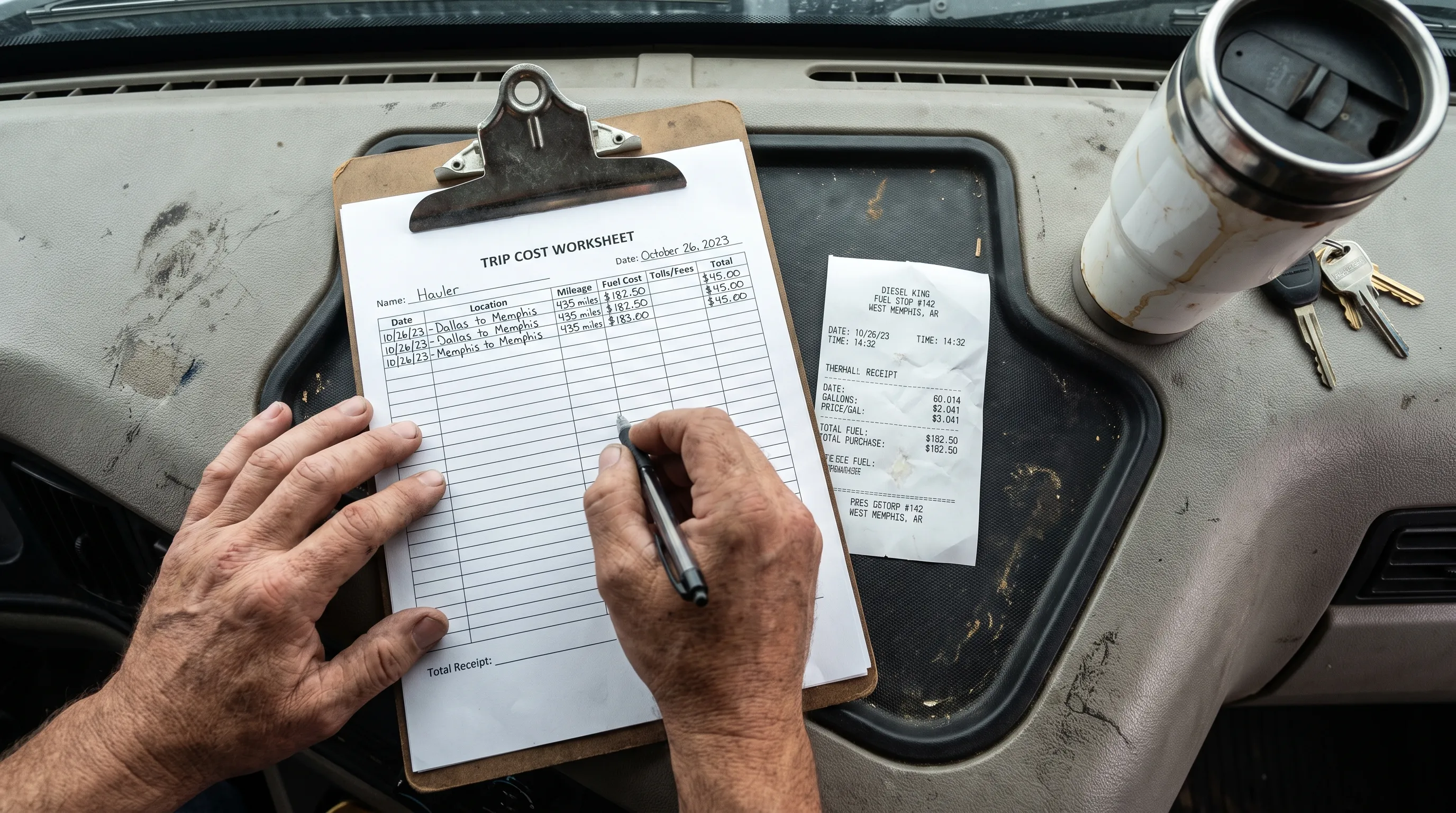
Over time, load rates become more useful when you compare estimated results with completed trips. Record actual total miles, fuel purchased, working hours, additional charges collected and payment timing. Note why the estimate missed: a loading delay, extra cleaning or an incorrect positioning distance.
Review results by lane and shipper. A consistently smooth $1,700 assignment may deserve a different minimum than a $1,800 job that regularly takes longer than promised. Your records should drive that judgment, not the largest number in the listing.
Frequently asked questions
Is a higher loaded-mile rate always more profitable? No. A higher rate can be offset by empty miles, waiting, extra handling or equipment costs. Compare the full trip’s revenue and costs, not just the loaded portion.
Should owner-operators include their own wages in trip costs? Yes, include a reasonable labor allowance when evaluating economic profit. Otherwise, the amount labeled profit combines compensation for your work with the return earned by the business.
Can a lower-paying return load still make sense? Yes, if it improves the result compared with traveling empty and fits your equipment, schedule and animal-care requirements. Confirm its incremental costs and check whether it displaces a better opportunity.
What should I track after delivery? Track total miles, working time, fuel, job-specific expenses, final revenue and payment timing. Comparing estimates with actual results makes future bids more accurate.
Start with a visible rate, then run your numbers
Transparent load rates let you screen an offer before spending time chasing details. They do not replace your cost calculation, but they make that calculation possible sooner.
Browse cattle and horse loads on Livestock Way, where loads show upfront rates and haulers can connect directly with shippers without a broker middleman. Use rig-fit matching to narrow the options, then confirm the scope and compare each payout against your own profit floor before accepting.