Now live across the Southern Plains — Amarillo · OKC · Fort Worth, and growing lane by lane


Livestock Vet
How to Vet Free Livestock Load Boards Before You Book
10 minutes read
Livestock Way
Free livestock load boards can help you find work without adding a subscription bill, but free access does not tell you whether a listing is current, a shipper is legitimate or a payment promise is reliable. Before you commit your truck, separate what the platform promises from what you can actually verify.
The goal is not to find a board that removes every risk. It is to find one that gives you enough information to investigate a load, reach the responsible party and document an agreement before you spend money getting there.
What trustworthy free livestock load boards make visible
Start by checking what “free” covers. Browsing, contacting a shipper and booking a load are different actions. A site may let you view listings at no charge while requiring payment to unlock phone numbers or respond.
Look for a clear explanation of subscription charges, transaction fees, optional upgrades and cancellation terms. If payment is required later, you should know what triggers it before submitting billing details. Do not assume that “no broker” also means “no platform fees.”
When evaluating free livestock load boards, check whether their advertised access matches the steps required to contact a shipper.
The operator should also be identifiable through a business name, working contact method and accessible terms and privacy policy. Even outside transportation, retailers such as MORALVE’s closet-organization shop make contact, terms and privacy links available in their navigation. A board requesting your business information should provide comparable transparency about who operates it and how that information is handled.
Those pages are a starting point, not proof of legitimacy. Test the support channel with a specific question: “Who can edit a listing, and what happens when a hauler reports inaccurate details?” A useful answer explains a process rather than simply saying the platform is safe.
Separate the platform check from the load check
A legitimate board can still carry an inaccurate listing. A genuine ranch can still post an outdated pickup window. Treat these as two separate checks.
The platform check covers ownership, fees, privacy, support and how listings are managed. The load check covers the person offering the job, their authority to arrange transport, the animals, the route and the payment agreement.
Ask what labels such as “verified” actually mean. Did the platform verify an email address, a business identity or something more? None of those automatically confirms animal counts, pickup readiness or the payer’s ability to pay.
Trustworthy free livestock load boards should make those distinctions understandable instead of leaving you to interpret a badge as a guarantee.
If you are still choosing between platforms, use a broader comparison of livestock load boards to assess route coverage and equipment fit. Here, the narrower question is whether the information behind one booking holds up to scrutiny.
Verify the person, not just the phone number
Call the contact before agreeing to the job. Ask for their name, business name, role in the shipment and relationship to the pickup location. Establish whether you are speaking with the owner, an employee, an authorized agent or an intermediary.
Then verify key details through a channel you find independently. A business website, an established contact you already know or a publicly listed office number can help. Calling only the number supplied in a suspicious message does not provide an independent check.
For an entity presenting itself as a motor carrier or broker, check the applicable federal records. The FMCSA SAFER Company Snapshot provides carrier information, while FMCSA’s Licensing and Insurance system can help you check applicable authority and insurance filings. Confirm that the business name and identifying numbers match the entity you are dealing with.
A ranch or livestock owner does not need a USDOT number merely to hire transportation. Federal records also do not authenticate a particular load, establish someone’s authority to act for a ranch or guarantee payment.
When using free livestock load boards, hold the booking if the contact cannot explain who authorized the shipment or which business owes you payment.
Pressure to commit immediately is not a substitute for a coherent explanation.
Test listing quality and rig fit
A useful listing lets you determine whether the job is plausible before driving anywhere. For cattle or horses, that means more than an origin, destination and headline rate.
Check the species, approximate head count and weight, required trailer configuration, loading arrangements and pickup window. Capacity depends on the animals and equipment involved, not just the posted number of head. A listing marked “livestock trailer” may still be unsuitable for your rig.
Ask when the details were last confirmed and whether the load is still available. If the board displays a posting date or status, compare it with what the contact tells you. If it does not, ask support how stale listings are removed.
Recurring contradictions deserve attention. A destination that changes without explanation, an unavailable pickup facility or a contact who cannot describe the animals is reason to pause, even when the rate looks attractive.
The strongest free livestock load boards give you enough detail to reject an unsuitable job early, rather than forcing you to discover the mismatch at pickup.
Save the listing and your correspondence before booking. This preserves what was represented, although your final written agreement should resolve any differences rather than leaving competing versions of the job.
Put the rate and payment terms on paper
An upfront rate is valuable, but it is not a complete payment agreement. Confirm whether the amount is a flat total, a per-mile rate or another arrangement. Establish which miles count and how additional stops, waiting time, cancellations or material changes will be handled.
For a hypothetical example, a $1,800 load covering 600 loaded miles looks like $3.00 per loaded mile. Add 150 deadhead miles to pickup and 50 miles of repositioning after delivery, and the same revenue becomes $2.25 per total mile across 800 miles. That is gross revenue, not profit, and it excludes operating costs.
For free livestock load boards, a visible rate should be the beginning of the payment check, not the end of it.
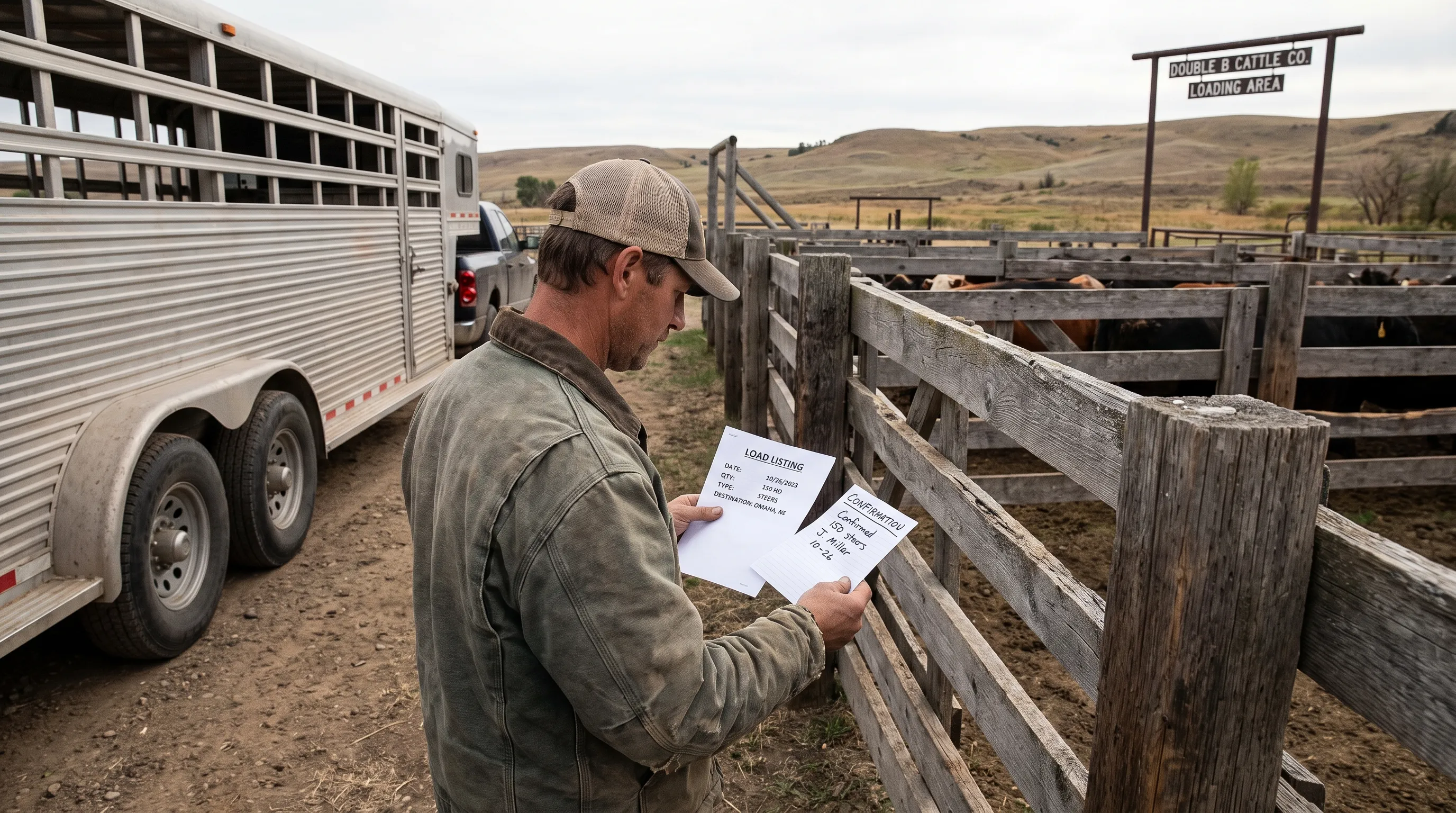
Get written confirmation of the following before accepting:
Responsible payer: The legal name of the person or business that owes the hauling charge and their billing contact.
Agreed compensation: The rate basis, total where applicable and treatment of authorized additional charges.
Payment timing: The due date or payment period and what starts that period.
Required documentation: The paperwork needed to submit a complete invoice and where to send it.
Changes and cancellation: Who can authorize changes and what happens if the shipment is canceled or materially different.
A platform’s direct-contact model does not make it responsible for the shipper’s debt. Ask whether payment protection exists rather than assuming it does.
Check privacy and payment-change procedures
Before uploading a carrier packet, find out who receives it. Some legitimate onboarding processes require insurance documentation or tax information, but the request should come from an identified party with a clear business purpose and an appropriate submission method.
Check whether your phone number is public, whether documents are visible to all users and how account deletion or document removal works. A board that cannot explain these basics may expose more information than you intended to share.
Never provide banking passwords or one-time security codes. If a message asks you to pay an unexpected fee, use a new bank account or follow a different payment link, verify the request through a previously established contact channel.
The FBI’s guidance on business email compromise recommends independently verifying payment requests and changes to account information.
On free livestock load boards, requests to send money to “release” a load or unlock promised payment deserve particular scrutiny. Do not let a pickup deadline rush you into a transfer you cannot explain or verify.
Decide whether to proceed, hold or pass
Use the same decision standard every time. That keeps a strong-looking rate from distracting you from unresolved identity or payment problems.
Decision | What you have established | Next action |
|---|---|---|
Proceed to final confirmation | Identifiable contact, independently checked business details, suitable equipment and written payment terms | Complete the operational checks before pickup |
Hold | A potentially legitimate job with missing or conflicting information | Ask for clarification and supporting confirmation before committing |
Pass | Refusal to identify the payer, unexplained payment demands or material details that remain inconsistent | Decline the job and report the listing through the board’s support channel |
“Proceed” does not mean every transport requirement is satisfied. Animal condition, applicable paperwork, loading access and route timing still need attention. Use the livestock transporter’s pre-pickup checks after the booking itself passes your screening.
The practical test for free livestock load boards is whether they help you reach a documented decision before you commit equipment and time.
If a contact will not resolve a basic question about authority, compensation or the actual shipment, leaving the load unbooked is a reasonable outcome.
Frequently Asked Questions
Does a free board mean the loads are unverified? No. Price and verification are separate issues. Ask what the platform checks, how it handles inaccurate listings and what responsibility remains with the hauler. A paid subscription is not proof that every load is legitimate either.
Does direct shipper contact guarantee payment? No. It can make it easier to clarify the job, but you still need to identify the responsible payer and agree on written payment terms. Do not assume the board will collect an unpaid invoice for you.
Should every livestock shipper have a USDOT number? No. A ranch or owner hiring a hauler is not automatically a motor carrier. Use federal carrier and broker records when they apply to the entity’s role, not as a universal test for all shippers.
What should I do if the listing changes after I accept? Pause and get the change confirmed in writing. Recheck equipment fit, timing, compensation and any relevant transport requirements before proceeding. Preserve the original listing and correspondence if you need to report a discrepancy.
Browse with a verification plan
Use free livestock load boards to identify opportunities, then verify the specific job before accepting it.
Livestock Way offers free load browsing and posting, upfront rates, rig-fit matching and direct shipper contact for cattle and horse hauling across the Southern Plains, including the Amarillo, Oklahoma City and Fort Worth corridor. It also provides 24/7 human support.
Start with a load that fits your equipment and route. Confirm the contact, settle the payment terms in writing and complete your pickup checks before committing the truck.